



Got Skeletons?

Every year I look forward to the trick or treaters coming to my home. I enjoy preparing weeks in advance buying only candy bars and Little Debbie cakes that I enjoy just in case there are any leftovers. Usually, the day of Halloween I need to buy more treats since some have already disappeared. I wouldn’t want to run out and must be prepared for the trick or treaters. I get such a kick out of seeing the ghosts and goblins that appear. Skeletons? Well, not so much. I guess it’s because it’s too close to home.

I’d like to say I have never had a skeleton in my closet, but there is not a word of truth in that. I had a rather big skeleton that enjoyed reminding me he was there. He scared me. I tried ignoring him by pushing him back in the closet and shutting the door. He didn’t go away. He kept reappearing either through a phone call, an e-mail, a letter in the mail, or an appearance on my credit report. It didn’t really matter how he made his appearance, he knew-and I knew- he was there. We both agreed he needed to leave my closet. He often reminded me of my error, which brought up feelings of embarrassment, failure and shame. These feelings I created with him, and just like my skeleton, I wanted them to all go away. He wasn’t going to leave me and would continue haunting me until I settled my debt with him. We needed to talk, and I needed to take action. No doubt, it was time to clean my closet.

I know we all have, or had, some sort of skeleton in our closet. The skeleton holds some piece of our past we would simply prefer to remain hidden or just totally forget. More often than not, it doesn’t remain hidden and we don’t forget. Recently, I cleaned my closet. I talked to my skeleton and took action to settle my debt with him.

I’d like to say I dance with my skeleton now, but there is not a word of truth in that.

Right now, I am repeating affirmations…

  • I forgive myself completely for mistakes I have made knowing I did the best I could at that time.
  • I let go of embarrassment, failure and shame.
  • I approve of myself.

I loving support you if it’s your time to clean your closet. There is every word of truth in that. Happy Halloween.

–Madeline Pallanes

Being With ‘What Is’

The first time I saw Daniel Nahmod in Tucson was the second time I set foot in the Center for Spiritual Living Tucson in spring 2009. There might have been 17 people in the audience. Daniel played acoustic, just him and a guitar, for 2 hours. He’s part of the reason I found this Center. That’s a story for another day. If you missed seeing Daniel Sunday, we’ve posted the service on our Facebook page YouTube page.

Among the many topics Daniel talked about Sunday — how he and his family got to continually adjust and readjust their expectations of the world, and what has been truly possible these past two years. Agreements he and his wife Melina made with each other and the divine have allowed them to stretch/grow in unexpected ways and directions. He’s also grown in his faith, trust and love, knowing the Universe works on his behalf.

****

Derek Sivers just released a new book How to Live, 27 conflicting answers and one weird conclusion. Derek is an American writer, programmer, a former entrepreneur and a musician. He accidentally started CD Baby in 1997 after his musician friends asked him to sell their CDs for them. He thinks a lot, and writes a lot. In this book, he analyzed as many points of view as he could find about how to live, and distilled them down to their essential points. As his title exclaims, these points of view disagree. What’s his one weird conclusion? We live in a world of paradoxes, the world of ‘and/both’, not a world of ‘one right way’, and we each get to decide how we wish to live our lives. So does everyone else. No one is wrong for their choice. It’s their choice.

******

In 2003, Byron Katie introduced the world to her process ‘The Work’ in Loving What is. She encouraged each reader to evaluate how much of their experience was actual-factual and how much was constructed by their own interpretation, and expectation, of events that happened in the past, or were anticipated in the future.

******

From Tolkien’s Lord of the Rings trilogy, “‘I wish it need not have happened in my time,’ said Frodo. ‘So do I,’ said Gandalf, ‘and so do all who live to see such times. But that is not for them to decide. All we have to decide is what to do with the time that is given us.’”

*******

Zen Buddhist teacher Adyashanti wrote in his 2011 book Falling Into Grace, Insights on The End of Suffering, “When we begin to surrender our demand that life change, that life alter itself to suit our ideas, everything opens up. We begin to awaken from this dream of separateness and struggle, and we realize that the grace we were always seeking is actually right there at the center of our own existence. This is the heart of spiritual awakening; to realize that what we have always yearned for is the very thing, in our deepest source, that we have always been.”

********

From Dr Ernest Holmes, The Science of Mind (110.3-111.1), “If we talk about discord, we shall become more discordant. The more the world arms for war, the more certain it is that there will be war. People who spend all their time talking about their unhappiness become more unhappy. Jesus understood these great laws of cause and effect in the Universe, which work sometimes with apparent slowness, but always with sureness. Eventually we shall understand that all human bondage is an invention of ignorance. Before we leave this subject of bondage and freedom, we wish to make clear that there is no sin but a mistake, and no punishment but an inevitable consequence.”

*********

Like all humans, I get to work with my beliefs and expectations. I know I reap what I sow. I do my best to most consistently sow the experience I choose, and dig out the weeds of “I wish life was different than it is” as quickly as I see them. It’s a continuous practice. The reward is being present with Life in all its glorious fullness.

–Rev Janis Farmer


A piece of the PIES

It has been a long break between the end of Practitioner 1 and the beginning of Practitioner 2 training. It feels good to settle into class and deepening my understanding and use of Science of Mind principles. The word “perfect” came up in our reading. We say it every Sunday “The Life of God is the only life there is, that Life is my life now, complete and perfect.”  And in my head I get stuck in the cultural definition of perfect, “being without fault or defect.” Biblical scholar Dr. Rocco Errico translates “perfect” from Aramaic meaning “inclusive of all things” (Practitioner II Training, Student Guide 24). Looking at the word “perfect” through a spiritual lens, I can resonate, be in-tune with perfection. The photo of Earth from space is a visual representation of “inclusive of all things.”

And the shift is not simply looking through a spiritual lens, but living primarily as a spiritual being.

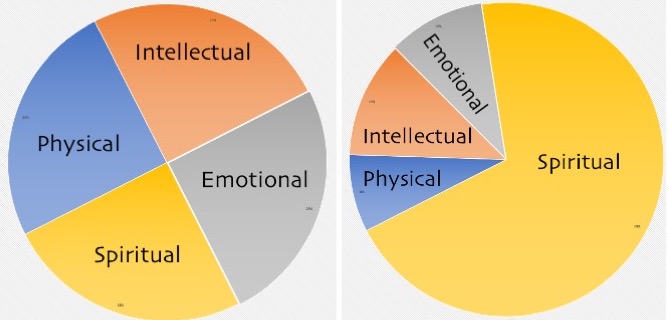
Elizabeth Kubler-Ross’ model of humans has four quadrants: physical, intellectual, emotional, and spiritual (PIES). As practitioners (anyone who practices Science of Mind) we tap into, expand living from our spiritual quadrant, using intuition more than thought, knowing our physical being is influenced by thought and emotion (release of hormones, cortisol, etc.), shifting away from the emotional realm of good/bad, drama, and judgement, choosing to live from a center of unity, wholeness… of perfection. It is a process of being more and more in the moment, bringing myself back to center.

you cannot allow yourself to be drawn into these things that you see and hear, or let them appear as realities to you. You have to be on the watch. In spiritual matters you have to watch your step, because it is easy to be led off into the contemplation of that which is not so, and to sympathize with that which has no reality. H. B. Jeffery, The Principles of Healing, 114.

Connecting with the invisible, One Source of all of Life, is my superpower. Knowing I have infinite possibilities available to me always and in all ways.

“And now here is my secret, a very simple secret: It is only with the heart that one can see rightly; what is essential is invisible to the eye.”  Antoine de Saint-Exupéry, The Little Prince  

Tao Te Ching

Chapter 11

We join spokes together in a wheel,
but it is the center hole
that makes the wagon move.

We shape clay into a pot,
but it is the emptiness inside
that holds whatever we want.

We hammer wood for a house,
but it is the inner space
that makes it livable.

We work with being,
but non-being is what we use.

–Maria


Who’s In Charge of ‘Me’?

We had an earth-shatteringly tremendous conversation in last week’s Revealing Wholeness class about what ‘The Body of God’ actually means. This is among the most difficult concepts in New Thought, because we, as walking, talking, living, breathing humans, don’t readily see our bodies and our lived experience as something that is temporary, infinitely changeable and infinitely malleable.

We glibly say, “There is Only One Life, That Life is God’s Life, That Life is Perfect, That Life is My Life Now” and “It’s All God” and “God is All There Is.” Some of us can even recite, from The Declaration of Principles that Dr Ernest Holmes wrote in 1927, “We believe in the healing of the sick and the control of conditions, through the power of this Mind.” And in answer to questions on the final exam for “Foundations of the Science of Mind” class, we answer, and in class discussions we talk about, ‘body’ as an effect, and ‘form’ as an effect and that cause is always invisible.

But push come to shove, what does that actually mean? Do we actually believe that our lived experience, and our physical body, is changeable by simply changing our thought patterns and beliefs and then changing our actions in support of those beliefs? On one level, the answer is absolutely yes. On another level… wait a minute, not so fast! We’re not so sure.

Holmes is pretty clear in The Science of Mind 98.4-99.2, where he wrote, “The word ‘body’, as used in The Science of Mind, means all objective manifestations of the invisible Principle of Life. The body is distinguished from the idea, in that the body is seen while the idea is invisible. The physical universe is the Body of God – the invisible Principle of All Life. Our physical being is the body of the unseen human. Behind the objective form of the rose is the idea that projects the rose. Body is always an effect, never a cause.”

Remembering that our bodies, and our lived conditions, are changeable by a change in our perceptions, our awareness and our consciousness are key to successful healing and manifestation through the use of spiritual mind treatments, affirmations and visualizations.

In The Seminar Lectures 15, Holmes wrote, “The perception of wholeness is the consciousness of healing.” Our biggest challenge is to remember that behind all experiences, and all visible presentations which look different than we would like them to be, there exist a perfect, whole and complete essence of each one of us. Our challenge is to remember that. We get to remember to perceive our lives, and our bodies through the lens of Wholeness, the eyes of God, and see ourselves as already perfected in our unseen human forms. At the core of everyone’s being there already exists an essential self that knows itself as living in, and as, the Divine.

We get to forgive, remove, or release anything that stands between our lived human experience and this pre-existing wholeness which are our True Selves. Once we no longer see ourselves as damaged, deficient, broken, or less than in any way, we can release those stories that limit our lived experience, and we can live rightly, as human expressions of the Body of God.

Indeed, this may be our life’s work, to see ourselves as God sees us, already whole, complete and perfect in every way, right now. Once we can do that, the scales fall off our eyes, and we can see ourselves and everyone else as the divine beings that they, and we, already are.

–Rev Janis Farmer

Friends in Far Places

I’ve met some amazing humans as part of the writing group practice that I’ve been in the past year.

Simon and I first met when we were matched up in a book-finishers group. I knew he was working on a book of bedtime stories for adults, but that didn’t intrigue me enough to read his early drafts. Once I read his draft book in its entirety, I realized he was on to something big. He’d realized that he had been parenting his children the same critical and demeaning way he’d been parented, and he wanted to do a healthier, happier, saner job with his own children.

Simon decided to write about his process of self-discovery, and extrapolated his own self-work into exploring positive techniques of communicating, correcting and engaging with his children, and his wife. His background is traditional fundamentalist Christian, and his mind is wide open to exploring how he can change how he engages with those in his world. I am delighted to have met him and get to encourage him in his progress. He published his initial book on Kindle, with intentions of polishing it, and publishing in print later.

Lately he’s been writing about doing more meaningful work, and deepening his satisfying relationships with the other adult humans in his life. He credits being part of this writing community and getting supportive feedback from all of us for his shift in his way of being. I thought there was probably more to it…

Last night he dropped in with this:

“I have done something every day for over a year now that has had a hugeimpact on my self-confidence. It is called the Self-Confidence Formula, 
and it comes from Napoleon Hill’s Think And Grow Rich. In the book, it 
is phrased as if these things would take place in the future. About a 
month ago, I changed what I say to state these things in the present 
instead of the future. I repeat it out loud, at least once a day.

First, I know that I have the ability to achieve the object of my 
definite purpose in life. Therefore, I demand of myself persistent, 
continuous action toward its attainment, and I here and now promise to 
render such action.

Second, I realize the dominating thoughts of my mind eventually 
reproduce themselves in outward physical action and gradually transform themselves into physical reality. Therefore, I concentrate my thoughts 
for thirty minutes daily upon the task of thinking of the person I 
intend to become, thereby creating in my mind a clear, mental picture ofthat person.

Third, I know through the principle of autosuggestion, any desire that Ipersistently hold in my mind eventually seeks expression through some 
practical means of attaining the object back of it. Therefore, I devote ten minutes daily to demanding of myself the development of 
self-confidence.

Fourth, I have clearly written down a description of my definite, chief aim in life, and I never stop trying. I am developing sufficient 
self-confidence for its attainment.

Fifth, I fully realize that no wealth or position can long endure unlessbuilt upon truth and justice. Therefore, I engage in no transaction 
which does not benefit all whom it affects. I succeed by attracting to 
myself the forces I wish to use, and the cooperation of other people. I induce others to serve me because of my willingness to serve others. I 
eliminate hatred, envy, jealousy, selfishness, and cynicism, by 
developing love for all humanity, because I know that a negative 
attitude toward others can never bring me success. I cause others to 
believe in me, because I believe in them, and in myself.

I have signed my name to this formula, I have committed it to memory, 
and I repeat it aloud once a day, with full faith that it is influencingand transforming my thoughts and actions so that I am becoming a 
self-reliant and successful person.

Signed, ___________, September 7, 2020.

I feel amazed, grateful, and exhilarated as I look back over the last 
year and see how I have grown and am growing into this firm declaration of belief in myself.”


Those of you who have read Napoleon Hill’s work, and have done this same practice recognize the covenant. Perhaps you studied it with Keith Gorley when he led a book study on this particular Napoleon Hill work several years ago. It’s not ever just about the studying, it’s about the application and the implementation.

I did smile when I read how Simon had changed Napoleon’s words from future tense to present tense. Good use of affirmations, man! And it’s the consistent, daily practice is critical.

As we move into a month exploring Edwene Gaines’ Four Spiritual Laws of Prosperity, we get to remember that prosperity is about a lot more than just money. As a member of a fundamentalist Christian faith tradition, I have no doubt that Simon is a tither. Beyond that, if you look at his assertions in his practice with Napoleon Hill’s covenant, you’ll see a very similar roadmap to the one that Edwene Gaines wrote about: goal setting, forgiveness and finding a divine purpose.

I’m excited to see what new pathways open up for those of us who choose to engage deeply with these principles and practices.

–Rev Janis Farmer

Concealing My Natural Bindi, No More

Over the past many months, not seeing people except on Zoom or wearing a mask when I did see someone in person, I stopped wearing any make-up. Now that I am starting to get out and show my face to others more, it was time to re-examined my make-up routine.

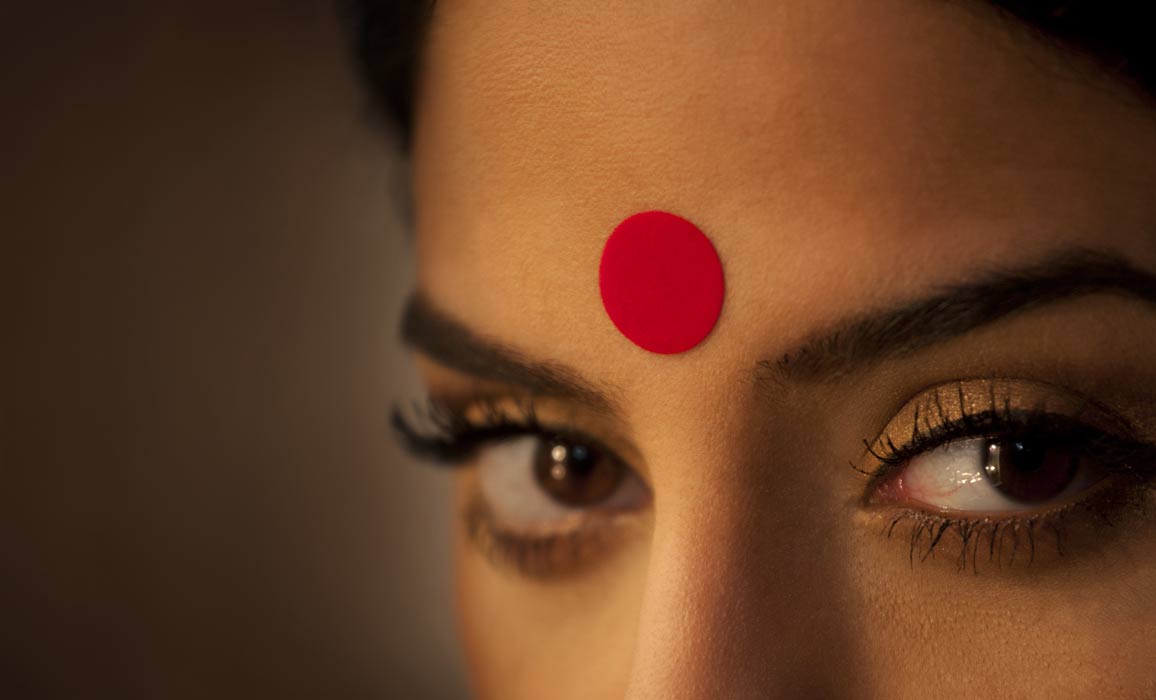
I have worn make-up to cover “flaws” and even out my complexion. Taking a good look at myself in the mirror, I noticed that the red patch between my eyebrows appeared more significant than before. It reminded me of the red dot Hindi women wear.

I did not know what it was called. An internet search led me to the following:
… one of the most internationally-known body adornments worn by Hindu and Jain women is the bindi, a red dot applied between the eyebrows on the forehead. … There are seven main chakras that run along the center of the body, and the sixth one (called the ajna chakra, the “brow chakra” or “third eye chakra”) occurs exactly where the bindi is placed.

In Sanskrit, ajna translates as “command” or “perceive,” and is considered the eye of intuition and intellect. … the bindi’s purpose is to enhance the powers of this chakra, specifically by facilitating one’s ability to access their inner wisdom or guru, allowing them to see the world and interpret things in a truthful, unbiased manner as well as forsake their ego and rid their false labels.

… The two physical eyes are used for seeing the external world, while the third focuses inward toward God. As such, the red dot signifies piety as well as serving as a constant reminder to keep God at the center of one’s thoughts. (The Purpose of the Bindi by Shuvi Jha June 5, 2018)

After reading that, I no longer saw my naturally occurring “bindi” as a flaw, something to be covered up. Maybe it’s a little more pronounced these days because my connection with my internal Guide is getting stronger. The inside is being reflected on the outside. I am listening to the internal voice more and allowing intuition to guide my actions. In fact, the intention I have been asking my fellow MasterMind group participants to hold for me is “Spirit Guides me. All is well.” My bindi is a visual reminder of this connection to Spirit. I will now proudly leave it exposed.